
Several questions arise on the appropriateness of the measure in the already strained fiscal scenario, says M Govinda Rao.
The minimum wage of Rs 80, which is applicable to central public sector undertakings, will see a 30 to 40 per cent jump in a single year once the changes are notified. The decision to hike the minimum wage level was taken by the Central Advisory Board at its meeting chaired by Minister for Labour and Employment Oscar Fernandes last week. The National Floor Level Minimum Wage of Rs 80 is likely to cross Rs 100 once the notification is issued.

Per capita income in the state has consistently been below the national average for at least 24 years. However, it has narrowed the gap with the all-India level in recent years.

With a large number of Indian youth aspiring to work in the railways, delays in filling up railway job vacancies were a point of criticism against the BJP in the run-up to the elections.

Exports contracted by 2.6 per cent to $34.47 billion in September even as the country's merchandise trade deficit narrows to $19.37 billion during the month under review, according to the government data released on Friday. Easing commodity prices helped in cutting down the country's import bill by 15 per cent to $53.84 billion in September, the 10th consecutive month of decline. During April-September this fiscal, exports contracted by 8.77 per cent to $211.4 billion.
The increased plan allocation from the Centre is expected to help Delhi complete various projects related to next year's Commonwealth Games. The city got Rs 814 crore for projects under the Jawaharlal Nehru Urban Renewal Mission, while Rs 315.82 crore has been proposed for providing basic services to the urban poor. The total allocation also includes Rs 1,129.82 crore given to the city under urban infrastructure development for small and medium towns.

Direct tax collections fell Rs 12,000 crore (Rs 120 billion) short of the Rs 3.87 trillion target last fiscal, largely owing to lower realisation from corporate tax payers.
The Union Budget for 2009-10 presented by the finance minister is on predictable lines. Surely, the finance minister has done a fine balancing act of giving a thrust to growth while trying to contain fiscal imbalance.

The technical report of the NSSO has generated controversy following its observation that as much as 36 per cent units forming part of MCA-21 database, used in computing GDP, could not be either identifiable or traceable in the field.

The stock of commercial vehicle (CV) company Ashok Leyland is up 46 per cent in the past three months, gaining despite worries about a slowdown in sales volume. Brokerages have a mixed view on the country's second-largest medium and heavy commercial vehicle manufacturer. The company reported steady March quarter results and its valuation, focus on growth and medium-term prospects are positive, but some brokerages are cautious, given near-term demand concerns and the risk of competition increasing in the industry.
High crude oil prices in 2008 have left the government richer by a few thousand crore rupees. In 2008-09, the government earned "windfall profits" from the petroleum sector as crude oil prices spiked, touching a high of $147 in July 2008.
Refraining from tinkering with tax and duty rates in the interim Budget, Finance Minister Pranab Mukherjee on Monday made a huge allocation of Rs 30,100 crore (Rs 301 billion) to government's flagship rural employment programme and many other schemes in a bid to counter the economic recession.

The country's leading cement maker UltraTech on Thursday said it will acquire a 23 per cent stake in its Chennai-based rival India Cements Ltd, in a deal estimated to be around Rs 1,885 crore. As part of the transaction, UltraTech Cement will acquire 7.06 crores equity shares of India Cements at a price of up to Rs 267 per share, according to a regulatory filing from the Aditya Birla Group flagship firm.
CAG recommended fixing a definite time frame for rolling out simplified GST return forms.

The previous high was recorded at 7.5 per cent in the July-September quarter of 2016-17.

In view of India's faster industrial growth and improved business confidence, UK-based Standard Chartered Bank (SCB) on Tuesday revised upwards its forecast for the country's economic growth to 8.1 per cent for the current fiscal.

The finance ministry will kick-start the exercise to prepare the annual Budget for 2023-24 from October 10, in the backdrop of revival of the Indian economy and fears of recession in developed countries. The budget for the next year will have to address critical issues of high inflation, job creation, boosting demand, and putting the economy on a sustained 8 per cent-plus growth path. On Wednesday, finance minister Nirmala Sitharaman said inflation is no longer "red-lettered" and the priority for the government now is job creation and boosting growth.

Citing faster-than-expected recovery, rising consumer confidence and the resultant spending spike, Swiss brokerage UBS Securities has revised upwards its growth forecast for the current fiscal to 9.5 per cent from 8.9 per cent in September. The brokerage also sees the economy clipping at 7.7 per cent in FY23 but moderating to 6 per cent in FY24, as it expects the benefit of the low-interest rate regime to end by the end of FY23, and it sees the central bank hiking policy rates by 50 bps in the second half of the next fiscal. The Reserve Bank also forecasts 9.5 per cent GDP growth this fiscal while the average projection ranges from 8.5 to 10 per cent.
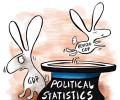
Whatever the claims about the new GDP numbers being technically superior to earlier estimates, their public credibility depends on their passing some reality checks, argues T N Ninan.
As part of its fiscal tightening measures, the finance ministry has asked all government departments not to seek any increase in their allocations for 2009-10 over and above what has already been provided for in the Interim Budget presented on February 16.

'It is entering growth territory on a month-on-month basis.'

For the cooperation ministry, the government made a total budget outlay of Rs 1,150.38 crore for 2023-24, lower than the revised estimate of Rs 1,624.74 crore for 2022-23.

India's economic growth slowed to 3.1 per cent in January-March and to an 11-year low of 4.2 per cent for the full fiscal 2019-20 amid a drop in consumption and investment. The Gross Domestic Product (GDP) growth stood at 5.7 per cent in the corresponding quarter of 2018-19, according to data released by National Statistical Office (NSO) on Friday.

The decision to cut development expenditure does not bode well for safety and amenities.
"Customs duty collection is likely to cross the budgetary estimate this year despite lowering of the peak rate. Barring external factors... economy will continue to grow at a high rate and manufacturing at a brisk rate," the finance minister said.

In January 2015, 25,023 tourists arrived by availing the scheme.

Only 80.6 per cent of the Rs 6-trillion allocation has been spent by February, data from the Controller General of Accounts shows.
Inflation surged to 5.48 per cent during the week ended December 23, just short of the upper threshold of Reserve Bank's projections for this fiscal, due to rise in prices of some essential manufactured products, food items and minerals.

Total disputed liability of Mallya with respect to service tax to the tune of Rs 535 cr
The government's subsidy bill on food, fertiliser and petroleum, among others, will fall by about Rs 18,000 crore (Rs 180 billion) at Rs 1,11,275 crore (Rs 1112.75 billion) this fiscal, mainly due to sharp reduction in the urea dole outs.

Ahead of the general elections, a slew of states and also the Centre had doled out sops to the marginalised sections, including the farmers and the poor.

Chief Economic Advisor (CEA) V Anantha Nageswaran on Thursday said describing India's recovery as 'K-shaped' was wrong as both rural and urban economies were recovering, albeit at different paces. Speaking to reporters at the Finance Ministry, Nageswaran said the gross domestic product (GDP) growth print for the recent October-December quarter (Q3FY23) will likely be revised upwards. "The notion of using the letter 'K' to denote urban and rural is somewhat wrong because it is almost as if one is growing and one is contracting. "I would say one segment's slope is more positive, and the other one slope is less positive but it is positive," Nageswaran said.
Chandigarh has highest per capita income of Rs 67,370 per annum, followed by Pondicherry (Rs 56,034) and Delhi (Rs 53,976).\n\n

the GDP estimates incorporate new source data and modified compilation techniques
The amount allocated for 2019-20 is 11 per cent higher compared to Rs 55,000 crore allocated for the year 2018-19.

In line with the industry expectations, the government has indicated that it is actively considering extension of the NBS regime to cover urea.
In spite of all the talk of helping the aam aadmi, the outlay under the Indira Aawas Yojana (IAY) for the rural poor in 2009-10 is more or less the same as in 2008-09 (revised estimate).

The petroleum ministry has asked for a total compensation of Rs 60,000 crore (Rs 600 billion) to cover the subsidy portion till the third quarter of the current financial year.

The government has budgeted to cut the fiscal deficit to 3.3 per cent of GDP or Rs 6.24 lakh crore in 2018-19, from 3.53 per cent in the previous financial year.
